KEYWORDS
Seed production, hatchery, microalgae, conditioning, spatting pond, sea-based collectors, image analysis, culture techniques, fouling treatment, oysters
SPECIES
- Crassostrea gasar (Mangrove oyster)
- Ostrea edulis (European flat oyster)
- Crassostrea gigas (Magallana gigas) (Pacific oyster)
GOALS
- To increase availability of spat of native and underutilised oyster species in Brazil and Scandinavia.
- To develop and optimise protocols for hatchery and sea-based production of oyster spat.
- To enhance and optimise existing grow-out protocols and techniques for both native and non-native oyster species to local conditions, improving economic sustainability of oyster culture in these regions.
GEOGRAPHICAL BOUNDARIES
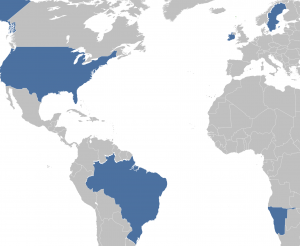
Case Study 8 “Improving seed availability and grow-out of native and non-native oysters” covers the entire Atlantic basin. The activities are performed primarily in Sweden, Ireland and in Brazil, but we work closely with partners on the US East Coast and in Namibia. There is a contribution to both the Belém and Galway Statements through its Atlantic wide collaboration.
CHALLENGES
- Underutilisation of oysters in Brazil and Scandinavia despite a high market demand and great interest from the aquaculture industry caused by:
- Low and/or inconsistent seed availability, suboptimal culture systems not adapted to local conditions;
- Low economic sustainability due to fouling compromising shell quality and marketability of the oysters.
- Restricted culture of the Pacific oyster; e.g., in Scandinavia due to the species classification as invasive.
- Pathogen outbreaks experienced worldwide reflect the importance of diversification of the oyster industry to increase resilience and adaptation potential to climate change.
EXPECTED RESULTS
- Increased aquaculture of native oyster species in countries around the Atlantic.
- Development of new hatchery protocols.
- Optimized sea-based seed production techniques.
- Optimized grow-out culture techniques.
EXPECTED USERS
- Small and medium-sized (SMEs) aquaculture companies
- Government organisations/licensing authorities
- Researchers
WORKPLAN
Hatchery protocol development for C. gasar will take place in Brazil, at AquaVitae industry partner Primar Aquacultura hatchery. There, native microalgae species will be gauged for their suitability in hatchery production and the effects of water quality on success will be evaluated. EMBRAPA will develop conditioning protocols using salinity manipulation treatments.
Development of spatting pond protocols for O. edulis will be performed jointly in Ireland and Sweden using multi-year trials including AquaVitae industry reference group partners and external industry partners.
Sea-based seed production trials will be performed in Brazil, Sweden, and Ireland to evaluate species specific substrate preferences and to develop protocols for optimising capture of native species. Software for automated species sorting will be developed by IVL in Sweden.
Trials related to adjustment of existing grow-out techniques will be performed in Brazil and Sweden. Development of new culture systems and heat-based treatments of fouling will be done in collaboration with Bohus Havsbruk.